If Classical Chinese Was Used as a Lingua Franca Again
Reclaiming a Common Language
How a new literary history could assistance salve wounds in Asia
Imagine if the Irish refused to read James Joyce because he wrote in English language, the tongue of the colonizer. Imagine if French historians willfully ignored ancient accounts of Gaul, because they were written in Latin, language of the invading Roman legions.
To a great extent, that is the attitude informing today's cultural and educational climate in Eastern asia. A vast trove of literature penned in Nippon, by Japanese poets, and for a Japanese audience is sorely underappreciated in Japan simply considering it was written in Classical Chinese, says Wiebke Denecke, a Higher of Arts & Sciences acquaintance professor of Chinese, Japanese, and comparative literature. Once the "Latin" of Eastward Asia, Classical Chinese was the shared linguistic communication of government, Buddhism, scholarship, and high literature for about 2 millennia. In the early 20th century, the Japanese, Koreans, and Vietnamese abandoned Classical Chinese, promoting their vernacular tongues equally their nations' official languages. One outcome of this was that the region lost a common literary heritage. Rediscovering Classical Chinese, Denecke argues, might help East asia heal the war wounds of the recent past.
A German native who has lived all over the world and is fluent in a dozen languages, Denecke was the East Asia editor for the Norton Anthology of World Literature (3rd edition, 2012). And this twelvemonth Denecke became the commencement BU recipient of an Andrew W. Mellon Foundation'due south New Directions Fellowship. The fellowship will allow Denecke to travel with her family to Prc, Korea, and Nippon throughout next year to research all-but-forgotten poetry from the seventh through twelfth centuries C.East. She believes these ancient documents may hold an important key to harmony in Eastern asia, promoting what she calls a "positive transnational identity."
"One of the things that makes Eastern asia distinctive is that they have a very long cultural tradition," Denecke says. That tradition has been carried through hundreds of centuries by a writing system still readable today. "You can encounter the dynamic of literary creation, reception, and renewal play out over a long duration, which nosotros cannot yet meet with the comparatively curt history of European vernacular languages. Once people realize that Classical Chinese was a tremendous nugget before the modernistic catamenia and the invention of 'national literatures,'" Denecke hopes, and then they can brainstorm moving toward reconciliation past looking back to a shared history.
The scripta franca
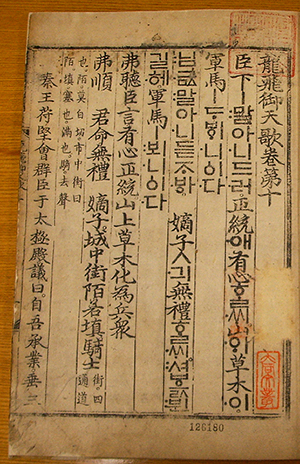
For almost two millennia, Classical Chinese was the lingua franca—or meliorate, Denecke says, the scripta franca—of Eastern asia. It uses a logographic script, in which each character represented not a audio but a give-and-take. The history of writing started with such scripts. But while cuneiform, hieroglyphs, and Mesoamerican glyphs take long since died out, Chinese—which is actually three millennia old, having been in use in People's republic of china for a k years before information technology began to spread—survives today as the world's simply logographic script. Equally the sphere of Chinese influence grew to include the preliterate areas now known as Nihon, Korea, and Vietnam, those peoples' rulers, diplomats, administrators, merchants, poets, and monks adapted the Chinese script and the literary language of Classical Chinese to their own utilize.
Few people even in the educated classes were bilingual—they spoke only in their own local vernacular—but well-nigh in the educated elite became "biliterate," as Denecke has explained in her latest book, Classical Globe Literatures: Sino-Japanese and Greco-Roman Comparisons (Oxford University Press, 2014). That meant they could write in their own colloquial as well as in Classical Chinese. When coming together with a foreigner, one would converse in "castor talk"—by passing notes back and forth. Although pronounced differently—often radically so—the same written Chinese characters had the same meanings for everybody across the region. Denecke likens this mode of communication to the Arabic numerals (1, two, three, etc.), "which are intelligible when American tourists write them downwardly during noisy negotiations over the price of a silk scarf in a market in Cairo."
Japanese, Koreans, and Vietnamese also used the Chinese script to write out their own vernacular, and they eventually developed their own scripts. (Today, Chinese characters are used only in Communist china, Taiwan, in hybrid grade in Japan, and in very limited fashion in Korea.) But Classical Chinese continued to serve as "the language of government, of church, of high literature" for the whole of East Asia, says Denecke. It was a highly convenient mode of advice for a multiethnic, multilingual region that shared similar education and legal systems, and literary and artistic traditions. Moreover, the script was a vehicle for the spread of ideas—of philosophy and religion, Confucianism and Buddhism. Then it remained until well into the last century. "My senior colleagues in Japan still talk nigh their grandparents writing poetry in Classical Chinese," Denecke says.
In the 19th and 20th centuries, nationalism swept the globe, with Due east Asia no exception. Roles reversed every bit Nihon grew imperialist ambitions and invaded and colonized many of its neighbors, including China and Korea. Those invasions left a legacy of bitterness that persists in the 21st century. For comparing, Denecke points to French republic and her native Germany, also ardent foes in the beginning half of the 20th century. Today, those nations are united by a common currency and even a parliament under the European Union, which would take been unthinkable 75 years agone. No such warming of relations has occurred in East asia, with nationalisms fueled by electric current economic and military competition. To this day, many Chinese refer to their old enemies as riben guizi, "Japanese devils." For their office, many Japanese downplay what Denecke considers the undeniable Chinese influence on their linguistic communication and culture.
As a issue, scholars in Japan—indeed, all along the fringes of Cathay'south old empire—focus solely on writings in their own national language, "which has led to this sad situation, where Japanese literature written in Classical Chinese is not taught in schools as office of Japan'southward national literary heritage," says Denecke. "At that place is a fading chip of training in Classical Chinese—reading Confucius and other Chinese classics—and there is vernacular literature. In between, there is an unacknowledged, gaping hole….This ancient collective cognition and retentivity has almost disappeared inside a couple of generations."
With her Mellon fellowship, Denecke, who has researched Chinese and Japanese literature and history for two decades, will address another gaping pigsty, namely the missing link in the story of Red china's influence on Japanese culture: Korea.
"Especially in the early on catamenia, most of Chinese noesis and products came to Japan through Korea: groovy artisans who knew how to make silk or Buddhist sculptures, and build monasteries. Especially during the Tang Dynasty, in the tardily 7th century, the Korean peninsula, formerly divided into iii Kingdoms, was unified under the country of Silla and the entire elite of the defeated state of Paekche fled to Nippon," she says. "Most of the composers of the earliest national chronicles and of poetry, and the professors at the newly founded Land Academy in the Japanese upper-case letter, were of Korean descent."
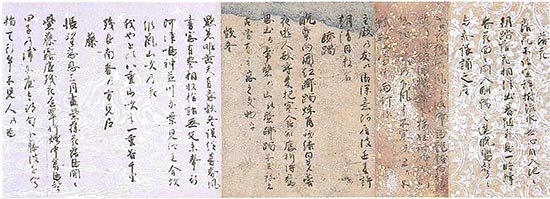
The fellowship will allow Denecke to pick up Korean, through intensive tutoring ("with a former BU colleague," she points out) and courses in Seoul ("aslope BU students studying Korean"), and to dive into premodern Korean literary studies. She will work on two book projects: one on the early history of Japanese verse, as seen through Chinese and Korean eyes, the other an illustrated album of poems written past Chinese, Japanese, and Korean envoys. For this i, she volition travel to sites across Nippon where foreign envoys stayed and conversed with the locals via brush talk. She volition sift through archives and visit related temples.
"Poesy played such a big role in East Asian affairs," Denecke says. "As an envoy, if you don't speak the language of your hosts, you're going to dash off a poem in Classical Chinese to express your friendship, to express your sense that you belong to the aforementioned common world."
Indeed, she adds, "poetry" is misunderstood when viewed through the lens of the W, where poetry has long been relegated to the realm of the personal and rarified. In traditional Eastern asia, she says, earlier the region imported Western notions of literature (as information technology did nationalism), "verse was the most esteemed genre, a tool for expressing one's worldview, showing i's historical and ethical judgment and one's cognitive powers of observation, and too a means of providing ethical guidance, entertainment, and helping advice between social classes, even the sexes. In brusque, verse encompassed the world and man life."
Winds of modify
When her work on the fellowship is washed, Denecke will take significantly expanded not but her own research profile, but BU's as well. Thanks to the intensive training in Korean, Denecke will be one of the very few scholars in the world conversant in the languages and classical literatures of China, Japan, and Korea. The timing is perfect, Denecke says, as her home section is currently developing a graduate program in comparative literature with a focus on Eastward Asia.
Being a Western scholar of classical Eastward Asian literatures comes with advantages. Denecke has been attending and cohosting conferences and workshops in Communist china and Nihon, and academics are sometimes more willing to mind to Denecke's outsider perspective than they would to the same facts presented by someone from only across the Yellow Sea. Some colleagues in that location take told her that the work she is doing is crucial, but that only scholars from exterior East Asia take a take chances to combat the nationalism distorting its literary studies. That positive reception gives her hope that the regional reconciliation she seeks can get a reality.
While instruction the BU class Classical Chinese for Students of East asia, Denecke has already seen signs of a thaw amid the immature Chinese, Japanese, and Korean students who share the classroom with their American peers. "They come up in with these very strong national identities," she says. "You tin can sense the tensions among these nations in the classroom. And the slap-up thing is, as the course progresses, and I assign them to read Chinese-style texts from Korea and Japan and so on, students really realize, 'My God, we have a shared heritage. Nosotros have to recover that.'"
That is ane reason Denecke loves teaching as much every bit she does research: "Y'all hope to make a difference in students' lives and teach them about other places, or for our Asian and Asian heritage students, their own places in a unlike way. Especially in a world that's then state of war-torn and where we're and so much divided by religion and ideology and whatever, doing that kind of very slow work of teaching and empathy with very unlike places in time and infinite, it's very meaningful to me."
A version of this story was originally published on BU Research.
Explore Related Topics:
Source: https://www.bu.edu/articles/2015/reclaiming-a-common-language/
0 Response to "If Classical Chinese Was Used as a Lingua Franca Again"
إرسال تعليق