Multidimensional Family Therapy for Adolescent Drug Abuse: Results of a Ran...: Ebscohost
A therapy that engages substance abusing teens and their parents individually while building the relationship between them has lasting benefits that extend beyond reduced drug utilize, according to two NIDA-sponsored, randomized trials. A yr after treatment, teenage participants treated with Multidimensional Family unit Therapy (MDFT) had fewer drug-related bug and had improved more than on general measures of beliefs and mental health than teens treated with cerebral-behavioral therapy (CBT).
Teens and Parents, Alone and Together
In MDFT, adolescent drug abuse is viewed as a complex phenomenon in which personal issues, interpersonal relationships, overall family functioning, and social forces must all be addressed to effect enduring modify. Some MDFT sessions involve both generations, some simply the adolescent, and some just the parent or parents. In joint sessions, the therapist guides parents and teens through discussions of family bug and introduces methods that build family strengths, improve communication, and reduce conflict. Counselors also aid families negotiate school, work, justice systems, and community service agencies.
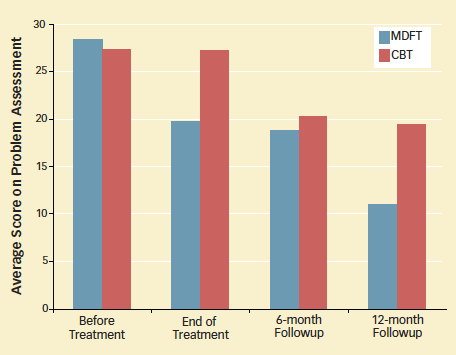 The Staying Ability of Multidimensional Family Therapy: Differences betwixt Multidimensional Family unit Therapy (MDFT) and cognitive-behavioral therapy (CBT) in reducing teens' social and behavioral consequences of drug abuse, equally measured by the Personal Experience Inventory, were about pronounced a year afterwards the terminate of treatment.
Sessions held exclusively with private teens aim to establish meaningful therapeutic goals, foster motivation, and aid the adolescents develop concrete strategies to solve problems and notice alternatives to drug taking and delinquency.
Sessions with parents include such topics as family management, the parent-adolescent relationship, and parenting skills, including monitoring and setting limits. These sessions besides provide opportunities to provide emotional support. "We connect with parents in a way that recognizes their stress and the anger, hopelessness, and fifty-fifty despair they may feel about their child," notes Dr. Howard Liddle of the Academy of Miami, who led the two studies. "And so we assistance parents reconnect emotionally to their kid. This renewed caring is instrumental in changing parenting practices.
"MDFT is a flexible and individualized treatment arrangement rather than a one-size-fits-all arroyo," says Dr. Liddle. MDFT has been used for young (11 to xv years quondam) and older adolescents and juvenile offenders. It has been applied in clients' homes, community-based clinics, residential handling centers, and correctional facilities.
Advantages Emerge Over Time
The setting for the outset of the 2 studies was a community-based drug corruption clinic. Two hundred and 20-four youths—predominantly African-American males, averaging 15 years of age, from depression-income, unmarried-parent homes—participated. Cannabis was the virtually usually abused drug; 75 per centum of participants were diagnosed as cannabis dependent, twenty percent booze dependent, and 13 percent dependent on other substances. The researchers randomly assigned half to receive MDFT and one-half, CBT.
The CBT intervention, similar MDFT, aimed to equip patients with skills not only to reduce drug abuse but also to cope with problems in many areas of life. However, unlike MDFT, it focused on individual, rather than family, development. Parents attended merely the first two sessions, during which they helped their children assess their problems and prioritize goals. To ensure high-quality commitment of both interventions, counselors trained extensively with manuals, and research assistants rated videotapes of the therapy sessions.
"CBT is an bear witness-based treatment that everybody knows about and likes, for good reason," Dr. Liddle says. He notes that the empirical prove supporting CBT for adults is potent and that similar evidence is emerging for adolescent populations besides. "Clinicians find it intuitive, logical, and if they have proper preparation, easy to exercise," he explains.
At the determination of therapy in Dr. Liddle'southward trial, CBT and MDFT seemed similarly constructive. Youths in the CBT group reported that they had used cannabis 10 times, on average, in the month earlier they started treatment; those in the MDFT group reported 12 days of such usage. By the last calendar month of treatment, both groups' use of cannabis had dropped, to 7.5 days and six days, respectively. A similar pattern held for use of any drugs or alcohol. At intake, 94 pct of the CBT group and 92 percentage of the MDFT youths reported using drugs or alcohol more than than once in the previous calendar month; these percentages had dropped to 77 and 73 percent, respectively, at discharge.
In the months after treatment, youths who had received MDFT fared better than those in the CBT group. Using a statistical technique called latent growth curve modeling, which compares rates of change over time, the researchers ended that by 6 months after the start of treatment, the benefits of MDFT had begun to outpace those of CBT. One yr after starting treatment:
- Youths assigned to MDFT had lower scores on the Personal Experience Inventory, which assesses impairment due to personal, social, educational, and legal problems tied to drug corruption.
- MDFT recipients were using drugs other than cannabis less frequently than before treatment, while such drug utilise past CBT recipients increased over pre-treatment levels.
- 47 per centum of youth treated with MDFT had used alcohol or drugs no more one time in the prior calendar month, compared with 28 pct in the CBT group.
MDFT Also Benefits Younger Teens
The second study tested MDFT versus CBT-based peer-group therapy in a younger group of boyish substance abusers—a population that is at especially high risk of worsening developmental problems, astringent and chronic substance employ disorders, low, school failure, and unemployment in adulthood. Eighty-3 teens, average historic period 13.5 years one-time, participated. Most had been referred to a substance corruption treatment programme past either their schools or the juvenile justice system afterward using alcohol or a drug during the thirty days prior to an initial assessment or demonstrating imminent risk for substance employ—for instance, past getting caught with drugs in their possession.
As in the study with older youths, MDFT therapists counseled families too as teens, just those conducting the alternate therapy did non work at all with families. Both treatments lasted 12–xvi weeks and addressed substance abuse together with associated problems, such as low self-esteem and schoolhouse and social difficulties.
As in the earlier study, both treatments were effective at discharge, just once once more MDFT recipients experienced longer lasting gains. At a followup assessment 12 months afterwards the adolescents started treatment, but 7 percent of the MDFT sample reported substance employ in the previous 30 days, compared with 45 percentage of youths who had received the CBT-based group therapy. Remarkably, the MDFT recipients' prevalence of drug utilise at this juncture also compared favorably with the charge per unit of 8.5 per centum reported past a nationally representative sample of eighth graders in the Monitoring the Future study.
In improver, during the followup year, MDFT recipients:
- improved their bookish performance, while the grades of youths who had had the CBT-based group therapy worsened;
- had fewer arrests and placements on probation;
- suffered fewer psychiatric symptoms, such as those related to depression and anxiety;
- reduced self-reported delinquency and associations with delinquent peers, while youths receiving the group CBT increased runaway peer involvement.
"Consistent with results from our other trials, outcomes of MDFT appeared to improve fifty-fifty after therapists completed their piece of work with teens and families," Dr. Liddle says.
The young teens demonstrated another MDFT benefit: Participants were more than likely to remain in handling—an important challenge in substance utilise interventions. In the MDFT grouping, 97 percent of the participants completed treatment, compared with 72 percent of those who had CBT-based group therapy. Dr. Liddle notes that these engagement rates are far superior to the average rate of only 27 percent amid those who completed 90 days of standard outpatient treatment in the NIDA-sponsored Drug Abuse Treatment Outcome Study (DATOS), a national written report of adolescent drug issues.
Therapy Powers HIV/STD Risk Reduction
In improver to reducing drug utilise, Multidimensional Family Therapy (MDFT) may besides meliorate a serious associated problem: behaviors that increase risk of human being immunodeficiency virus (HIV) infection and other sexually transmitted diseases (STD). Acting data from a trial sponsored by NIDA's Criminal Justice–Drug Abuse Handling Studies (CJ–DATS) program support that suggestion. Participants were recently released juvenile offenders who were abusing drugs, a population in which risky sexual behaviors, such every bit unprotected sexual practice, are especially widespread.
In the trial, 154 adolescents were randomly assigned to receive MDFT or usual services. While in detention, adolescents in both treatment groups had received a standard educational, one-session Centers for Disease Control HIV/STD take chances-reduction program. After release and 1 to ii months of therapy, adolescents in the MDFT group and their parents participated in 3 2-60 minutes multifamily group sessions designed to raise sensation of HIV/STD risks and encourage behavior changes to reduce them.
Information collected 6 and 9 months afterwards release from detention were "generally promising," Dr. Liddle says. Nearly impressively, co-ordinate to Dr. Liddle, the rate of new infections declined over this menstruum in the MDFT group. The researchers plan to track the teens for 42 months.
Dr. Liddle speculates that to the extent the intervention proves effective, it will reflect the ability of family involvement. "Attending to and reducing loftier-take a chance sexual beliefs is framed in the same way we approach adolescent drug taking," he says.
Dr. Akiva Liberman, formerly of NIDA's Division of Epidemiology, Services and Prevention, describes MDFT as "very relevant and advisable for adolescents involved in juvenile justice. These youths face an array of problems—private, social, and family. MDFT seems to be a natural fit."
Sources
Liddle, H.A., et al. Implementation Outcomes of Multidimensional Family Therapy-Detention to Community (DTC)—A Reintegration Program for Drug-Using Juvenile Detainees. International Journal of Offender Therapy and Comparative Criminology. Published online earlier print April 28, 2010, [Abstract].
Curiosity, F., et al. Multidimensional family therapy HIV/STD risk-reduction intervention: An integrative family-based model for drug-involved juvenile offenders. Family Process 48(1)69–84, 2009. [Abstruse]
In both of Dr. Liddle'due south studies, MDFT was administered by therapists from community-based drug-treatment agencies. "This suggests that the approach may be readily generalized to a serve a wide population," says Dr. Liddle. "MDFT treatment outcomes are among the best there are for adolescents," says Dr. Lisa Onken, chief of the Behavioral and Integrative Co-operative of NIDA'due south Division of Neuroscience and Behavioral Research. "Not only does it work, just it joins the category of behavioral interventions whose furnishings seem to endure subsequently treatment ends."
Sustainability of treatment effects, as indicated by 12-month outcomes, was "the most important finding" of the studies, she says. "This is important particularly for younger adolescents, who would be on a very negative developmental trajectory without constructive handling."
Dr. Onken would similar to run into further research to place which aspects of MDFT get in effective. "This is a very complex treatment, and the more nosotros can figure out the essential ingredients—what is critically important and what is of lesser importance—the meliorate nosotros will exist able to implement it in the community," she says.
Dr. Liddle notes his team and others have begun piece of work along these lines.
Sources
Liddle, H.A. Treating adolescent substance abuse using Multidimensional Family Therapy. In J. Weisz and A. Kazdin (eds.). Bear witness-based Psychotherapies for Children and Adolescents (2nd ed.), New York: Guilford Press, pp. 416–432, 2010.
Henderson, C.East., et al. Parenting practices as mediators of treatment effects in an early on-intervention trial of Multidimensional Family Therapy. American Journal of Drug and Alcohol Abuse, 35:220–226, 2009. [Full Text (PDF, 336KB)]
Liddle, H.A., et al. Multidimensional Family unit Therapy for immature adolescent substance abuse: Twelve-month outcomes of a randomized controlled trial. Journal of Consulting and Clinical Psychology 77(1):12–25, 2009. [Abstruse]
Liddle, H.A., et al. Treating adolescent drug abuse: A randomized trial comparing Multidimensional Family Therapy and cognitive beliefs therapy. Addiction 103(10):1660–1670, 2008. [Abstruse]
Source: https://archives.drugabuse.gov/news-events/nida-notes/2010/12/multidimensional-family-therapy-adolescent-drug-abuse-offers-broad-lasting-benefits
0 Response to "Multidimensional Family Therapy for Adolescent Drug Abuse: Results of a Ran...: Ebscohost"
إرسال تعليق